
Net Metering/Green Meter
In Pakistan, we are currently facing two issues in the power sector: high prices and an electricity shortage. We are facing severe load shedding, which worsens in the summer. During peak summer hours, there is load shedding every hour.
Net metering or Green Meter is the best remedy for these issues. When we receive our bills, we are shocked by the amount compared to the power supply and consumption. Govt is charging higher unit rates and also includes taxes and duties in bills to overcome the shortage of money.
In recent days, a significant development occurred in the power sector, particularly in solar systems. Now, awareness of solar systems in Pakistan is growing. Our people are shifting their load to solar systems. They are installing higher-capacity solar systems than their demand.
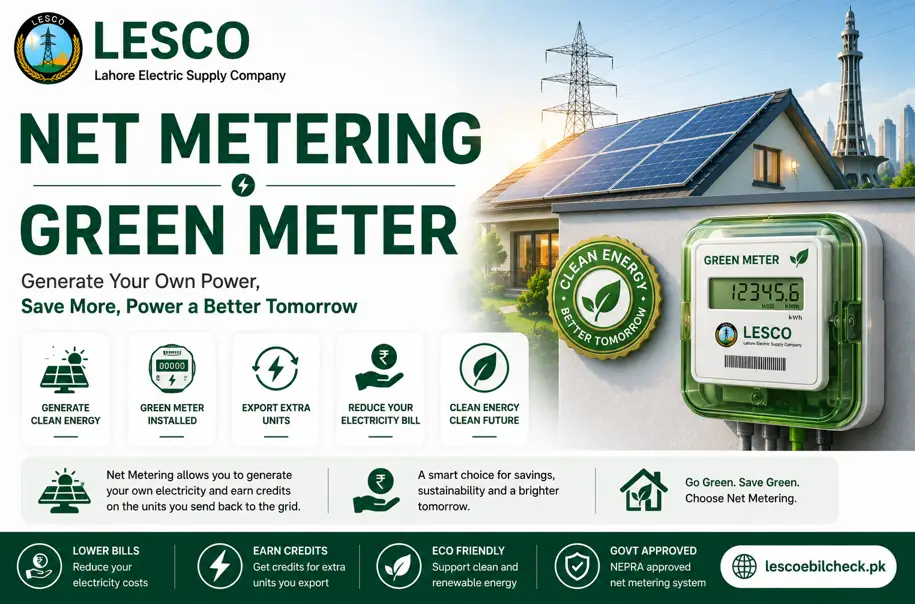
They sell the excess electricity to the national grid. It not only reduces their monthly bills but, in some cases, even covers the cost. This is called Net Metering or Green Meter.
Learn about net metering and green meters: how to install them, required documents, reading guidelines, unit prices, and other important details in this article.
How does it work?
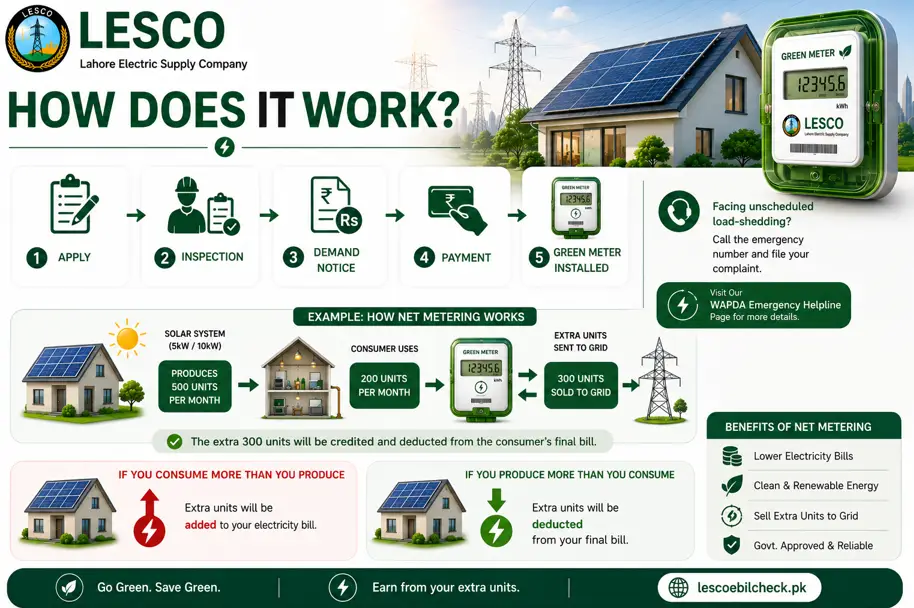
When a consumer wants to install a Green Meter, they must submit an application to the relevant Disco. After inspection, a demand notice is issued to the consumer. When he pays the demand notice, a three-phase green meter will be installed at his premises.
If you are experiencing unscheduled electricity load-shedding, you can file a complaint by calling the emergency number. For more details, visit our WAPDA Emergency Helpline page. Now, you can easily calculate your bill once you know the units you consumed.
To know how it works, we can explain it in simple words:
“ A consumer has installed a solar system of 5kV or 10kv and it produces 500 units per month. But the consumer consumes only 200 units monthly, and the extra 300 units he will sell to the national grid. It will be deducted from his final bill.”
If a consumer consumes more units than his system is producing, they will be added to his bill. If his system produces more units than he consumes, the excess will be deducted from his final bill.
The Process of Applying for Net Metering?
We will discuss in detail the process of applying for a green meter in Pakistan.
Active Connection
First, the consumer must have an active electricity connection with the relevant DISCO. He should have a billing history.
Solar System Installation
Solar systems should be installed before applying for this. The system should have more capacity than the consumer’s usage. For example, if a consumer consumes 300 units in a month, the system’s capacity should exceed 300 units.
Preparation of Application
After installing the solar system, the next step is to prepare an application in accordance with the rules of SRO 892(1) 2015. For assistance in this process, you may contact any AEDB-registered solar company.
They will guide you and can apply for this on your behalf. They will assist you and guide you through all the required documents and steps.
Inspection and NOC Issuance
After you submit your application to the Punjab Energy Department, they will inspect your premises and get all the required information. When they are satisfied with all the requirements, they will issue a No Objection Certificate ( NOC ) in line with SRO 892(1) 2015.
This means that all required regulations and standards are followed and maintained.
Signing of Agreement
When an NOC is issued, an agreement will be made between the producer and the local DISCO, such as LESCO, for a 3-year period. This means you can now sell the electricity you produce to the DISCO on the National Grid.
Allotment of Generation License
After signing an agreement, your application will be forwarded to the National Electric Power Regulatory Authority ( NEPRA ) for verification. After verification of all requirements, NEPRA will give you a Generation License.
This license will recognise you as an Independent Power Producer and will grant you permission to produce and sell electricity to the National Grid for the next 3 years.
Activation of Net Metering
When you get your license as a power producer, your service will be activated. For this, you will get a three-phase green meter installed at your premises. Now, you have the opportunity to sell electricity to save and earn money.
Green Meter Rates in Pakistan
Here, we will discuss Green Meter Unit rates in Pakistan in detail. It is also called a net metering tariff, but before that, you should know some billing terms.
Peak Hours
During these hours, power consumption is higher than during normal hours. Normally, the peak hours are 6 pm to 10 pm in the summer. During these hours, the unit price is higher than during normal hours.
Off-Peak Hours
The remaining 20 hours are called off-peak hours; during these hours, the consumption is normally low. The unit price for these hours is lower than that of peak hours.
If you want to study in detail about peak and off-peak hours, you can visit our Home Page
Tariffs for peak and off-peak hours are different. It is Rs 14 per unit for off-peak hours and Rs 24.33 per unit for Peak hours.
Import Units
These are the units we import from the national grid when our system is not producing enough power to meet our demand. Normally, at night and during peak hours, our system produces low output because there is no sun, and we draw power from the backup system, which is the Battery.
When our batteries are exhausted, our system imports power from the national grid to fulfil our demands, and the meter runs forward. These are negative units for us and are excluded from exported units.
Export Units
During the daytime, when our system is operating at full capacity, it produces more units than we need. These extra units are transferred to the national grid and are called export units. This happens during the daytime when the system produces more power than we demand, and extra units are supplied to the national grid.
During this time, the meter runs backwards and is called a negative reading. These units are our strengths, and we receive payment for them from our DISCO.
How is Reading Done?

There are 4 readings for a green or net meter in the net metering bill every month. We can easily understand them by their numbers because every reading has a specific number. These four numbers are 6, 7, 8, and 9.
The number 6 represents units imported during peak hours.
The number 7 represents the units exported during peak hours; normally, these are zero because there is no sunlight at night time.
The number 8 represents the units imported during off-peak hours.
The number 9 represents the units exported during off-peak hours. Mostly, we export electricity during off-peak hours.
DISCOs sell electricity at higher rates and purchase at lower rates, so the net bill is calculated based on net unit prices.
Net Billing / How Bill is Calculated
The bill is calculated differently for off-peak and peak hours, and then the net or final bill is determined.
Bill for Off-Peak Hours
During off-peak hours, we export power to the grid and consume less. For this, readings will be taken differently, and the bill is calculated by excluding import units from export units. We can explain it using the diagram and the table of units consumed and exported below.

For example, if we consume 50 units in off-peak hours and produce 300 units, then the bill is calculated as under:
| Type | Units | Price Per Unit | Total Price |
| Import | 50 | 14 | 700 |
| Export | 300 | 14 | 4200 |
| Net | 50-300 | 14 | -3500 |
The negative sign shows that this amount is payable to the consumer and will be deducted from the peak-hour bill.
Bill for Peak Hours
During peak hours, the consumer consumes more energy than he produces, and his bill is calculated as follows.

For example, if a consumer consumes 100 units of electricity during peak hours and does not export any units to the national grid, then his bill will be calculated under
| Type | Units | Price Per Unit | Total Price |
| Import | 100 | 20 | 2000 |
| Export | 0 | 20 | 0 |
| Net | 100-0 | 20 | 2000 |
This means that the consumer has to pay this amount to their related DISCO.
Net Bill
The net bill will be calculated by excluding peak-hour bills from off-peak-hour bills, as

| Peak Hour Bill | Off-Peak Hour Bill | Net Bill |
| 2000 | -3500 | -1500 |
The negative sign indicates that the customer has a charge of this amount with the electric company, and it will be adjusted on next month’s bill.
But if there is a positive sign, it means the consumer has to pay this amount to the electric company.
Note: All the values used in the tables are intended to make understanding easier.
Quarterly Arrangement
The year is divided into 4 quarters based on peak-hour timings, which change every 3 months. At the end of a quarter, if you have a positive bill, you have to pay this bill, but if you have a negative bill, then you can avail of any one option from below
- Adjust in the next quarter
- Cash out the amount
Normally, people prefer the 1st option because it is convenient, and the 2nd option involves a lengthy procedure.
Benefits of Green Metering
This offers many benefits to consumers and the power department. Here, we will discuss some of them.
Reduce Electricity Bills
It allows consumers to sell electricity to the national grid. It will reduce their bills and allow them to save.
Return on Investment
Installing a solar system requires a significant investment, but we can recoup it by selling excess units to the national grid. It will help us make some savings and replace the system when its physical life is over.
Energy Independence
When a consumer installs a solar system, they become independent of the national grid and can enjoy electricity without any disruptions or load shedding.
Creating Jobs
As demand for solar systems increases, it will increase demand for installers, electricians, and other labourers involved in the installation process. This will also increase investment in the power sector and positively affect the economy.
Environmental Sustainability
One of the most important advantages of this is its positive impact on the environment. It uses sunlight to generate electricity and reduces the use of fossil fuels in electricity production. This ultimately decreases air pollution and preserves the environment.
Grid Stability
When more people use solar systems and produce their own electricity, it will decrease the demand for electricity from the national grid. When the load decreases on the national grid, it will improve performance and stability and reduce line losses.
New Net Metering Policy
Now, the government has introduced a new net metering policy to address revenue shortfalls resulting from solarisation. Now, the government has set the purchasing price from consumers at Rs 15 per unit. Now, the government has stopped net metering for new consumers, and they are priced at a higher level. Now, the sold units are not deducted from the consumed units; rather, the sold units are priced at Rs 15 per unit, and the consumed units at approximately Rs 45 per unit.
But the old green meter holders are not included in this new policy, and they will continue to enjoy net metering until their agreed period ends. To get the latest news regarding net metering, stay connected.
Conclusion
By using a Green Meter, we can sell our excess electricity to the national grid and get relief on our power bills. It not only helps us reduce our bills but also shortens the solar system’s payback period.
It provides an uninterrupted power supply and helps conserve the environment. But we have to follow a standard procedure to install it. If you still have any issues or want to discuss something else regarding this, feel free to contact us.